
NBA Same-Game Parlay: Complete SGP Strategy Guide
 Available in US
Table of Contents
Same-game parlays have transformed how bettors engage with NBA action. What once required placing separate wagers on individual outcomes now lives within a single, customizable bet that combines multiple propositions from the same game. The appeal is obvious: higher potential payouts, the thrill of having multiple rooting interests within one contest, and the creative freedom to construct bets that reflect your specific read on how a game will unfold.
The explosion of SGP popularity is not accidental. Sportsbooks aggressively market these products because they generally carry higher margins than straight bets. Bettors love them because they offer a way to leverage specific game predictions into substantial payouts. This tension creates both opportunity and danger. Approach SGPs with a coherent strategy, and you can find genuine value where sportsbooks misprice correlated outcomes. Approach them casually, throwing together random legs because the payout looks attractive, and you are essentially lighting money on fire.
This guide provides a systematic framework for building NBA same-game parlays that make analytical sense. You will learn how correlation works, which prop combinations offer real value, and how to avoid the structural traps that doom most SGP bettors to long-term losses. The goal is not to chase unlikely jackpots but to construct parlays where each leg supports the others and the combined probability exceeds what the odds suggest.
What Is a Same-Game Parlay?

A same-game parlay combines multiple betting selections from a single NBA game into one wager where all legs must hit for the bet to win. Unlike traditional parlays that might span several games across different sports, SGPs focus entirely on one contest, allowing you to bet on the spread, total, and multiple player props all within the same ticket.
The mechanics work similarly to standard parlays but with a crucial difference in how odds are calculated. In a traditional parlay, the odds simply multiply across independent events. If you combine two -110 legs, the parlay pays roughly +264. Same-game parlays adjust these calculations to account for correlation between outcomes. If you combine a team to win with their star player to score over 25 points, the sportsbook recognizes these outcomes are not independent and reduces the payout accordingly. The star scoring heavily and the team winning are positively correlated events that happen together more often than random chance would suggest.
Sportsbook offerings vary significantly in SGP functionality. Some platforms allow extensive customization with dozens of available legs per game, while others limit your options to mainstream props and game outcomes. The number of legs permitted also differs. Most books cap SGPs somewhere between six and fifteen selections, though the practical ceiling for profitable betting is much lower. User interfaces range from intuitive drag-and-drop builders to clunky systems that make comparing options tedious. If you plan to bet SGPs regularly, having accounts at multiple sportsbooks gives you access to different market structures and potentially better prices on specific combinations.
The structural difference from traditional parlays has significant implications for strategy. When you parlay outcomes across different games, each leg is genuinely independent. The Celtics covering their spread has no relationship to the Lakers going over their team total in a separate game. But within a single game, most outcomes exhibit some degree of correlation, positive or negative. Understanding these relationships is fundamental to building SGPs that offer actual value rather than sucker bets dressed up in attractive packaging.
How Correlation Works in SGPs

Positive correlation describes outcomes that tend to happen together. When one leg of your parlay hits, the probability of another leg hitting increases. The classic example is combining a player’s points over with his team winning. If the player scores heavily, his team probably had a good offensive night and likely won. These events reinforce each other. Sportsbooks account for this by reducing your payout compared to what you would get if the legs were truly independent.
Negative correlation works in reverse. When one leg hits, another becomes less likely. Betting a game to go under the total while also taking a player’s points over creates tension within your parlay. Low-scoring games generally mean fewer points for everyone, including the player you need to exceed his line. These conflicting legs work against each other, yet sportsbooks still price them as if you are adding risk when you have actually constructed an internally contradictory bet that has lower probability than either leg alone.
Understanding how sportsbooks price correlated legs reveals where value might hide. Books use models to estimate how much correlation exists between outcomes and adjust payouts accordingly. But these models are imperfect. They might underestimate how strongly a specific player’s performance correlates with game outcomes, or they might fail to account for situational factors that make certain correlations stronger than usual. When the book’s correlation adjustment is smaller than the true relationship warrants, you have found an edge.
Finding mispriced correlations requires thinking beyond obvious relationships. Everyone knows that a team winning correlates with their star player performing well. The pricing reflects this obvious connection. But consider secondary effects. If a team wins comfortably, their bench players log more minutes in garbage time, potentially boosting role player props. If a game goes to overtime, everyone on the floor gets extra statistical opportunities. A fast-paced game benefits guards who thrive in transition more than plodding big men. These nuanced correlations receive less sophisticated treatment in sportsbook models, creating opportunities for bettors who understand the game deeply.
The practical implication is that your SGP should tell a coherent story about how the game will unfold. Each leg should support the others logically. A blowout prediction pairs naturally with starters seeing reduced fourth-quarter minutes and bench players exceeding their lines. A defensive struggle pairs with unders on shooting props and possibly overtime if both teams struggle to pull away. When your legs fit together into a sensible narrative, you are building on positive correlations. When they conflict or seem unrelated, you are probably donating money to the sportsbook.
Building Winning NBA Same-Game Parlays

Successful SGP construction begins with developing a game narrative before selecting any legs. Rather than browsing available props and combining whatever looks attractive, start by analyzing the matchup and forming a hypothesis about how the game will play out. Will it be a high-scoring affair or a defensive grind? Is one team likely to dominate, or does the contest project as a close battle? Which players are positioned for big nights based on matchups and opportunities? Your answers to these questions should guide every selection that follows.
Matching props to expected game flow creates internal consistency within your parlay. If you project a high-scoring game driven by fast pace and poor perimeter defense, select props that benefit from that environment. Points overs for primary scorers, assists overs for playmakers running the offense, and three-pointer overs for shooters facing weak closeouts all align with the high-scoring narrative. Mixing in rebounds overs for big men who crash the offensive glass capitalizes on the additional missed shots that come with high-volume shooting. Every leg reinforces the same underlying prediction about how the game will unfold.
High-scoring game SGP builds focus on offensive production and pace-related statistics. Take team totals over rather than game totals to avoid needing both teams to cooperate. Combine this with points overs for players whose scoring correlates with their team succeeding offensively. Add assists overs for point guards who facilitate in uptempo systems. Three-pointer made props work well when both teams shoot frequently from deep and neither plays strong perimeter defense. The common thread is that each selection benefits from the same game conditions you are predicting.
Low-scoring defensive battle builds require flipping the script entirely. Team totals under, points unders for players who struggle against elite defense, and rebounds overs for big men who benefit from lower shooting percentages form a coherent package. When shots do not fall, someone has to collect the misses. Defensive specialists who might exceed their steals or blocks props fit naturally into this narrative. The key is recognizing that a defensive slugfest creates a completely different statistical environment than an offensive showcase.
Blowout game strategies present unique opportunities because they affect playing time distribution. If you project a lopsided outcome, the winning team’s starters will likely sit extended fourth-quarter minutes while bench players mop up. This creates value on unders for the favored team’s stars, who might hit their prop lines by halftime but never get the chance to exceed them. Simultaneously, backup players on the favored team see inflated minutes and might smash through their typically low prop lines. For the losing team, starters often play heavy minutes in comeback attempts, potentially boosting their raw statistics even in defeat.
Best Prop Combinations for SGPs

Player performance combined with team outcomes represents the foundational SGP structure because the correlation is strong and well-understood. A star player scoring heavily usually means his team had a successful offensive night, which correlates with winning. Taking LeBron James over 25 points alongside the Lakers moneyline creates a parlay where both legs become more likely if the other hits. The sportsbook accounts for this correlation, but the adjustment is not always accurate, especially in specific situational contexts where the relationship is stronger than average.
Correlated player prop pairs within the same team offer another avenue for smart construction. The primary ball-handler’s assists over pairs naturally with the team’s best shooter exceeding his scoring line. If the point guard is dishing at a high rate, someone is converting those opportunities into made baskets. Similarly, if a team’s offense is flowing through their center in the post, his scoring over correlates with reduced touches for perimeter players, potentially creating value on their unders. These intra-team relationships require understanding how specific offenses generate their points.
Quarter and half props add granularity to your SGP when you have strong convictions about game flow. If you expect a team to start slowly due to travel or a tough back-to-back, first-quarter spreads or totals might offer value that full-game lines do not capture. If you project a close game that one team will win in the fourth quarter based on superior depth, combining a tight halftime margin with a comfortable final victory creates a narrative-consistent parlay. These time-segmented props let you express more specific predictions than full-game outcomes alone allow.
Certain prop combinations should be avoided because they create internal tension or rely on unlikely convergences. Combining a player’s points under with his team scoring heavily makes little sense unless you expect him specifically to struggle while teammates flourish. Taking a game total over while betting unders on both teams’ primary scorers assumes random role players will pick up the slack, a lower-probability scenario than the payout suggests. Props that require opposite game conditions to hit simultaneously are mathematical traps regardless of how attractive the combined odds appear.
The specific props you should avoid combining also include same-stat overs for players who compete for the same opportunities. Two guards on the same team both going over their assists lines requires an unusual distribution of playmaking duties. Two big men on the same team both crushing rebounds requires enough missed shots for both to feast, which becomes less likely as the total decreases. When players compete for limited statistical opportunities, treating their props as independent events overstates your actual winning probability.
SGP Strategy by Game Type
Rivalry games present unique SGP dynamics because they often feature heightened intensity that affects statistical outputs in predictable ways. These contests tend to be tighter than the talent gap suggests, with underdogs playing above their usual level and favorites sometimes struggling with the emotional weight of the moment. Player props for stars who thrive under pressure become more attractive, while role players who might shrink from big moments present under value. The increased physicality often correlates with lower scoring and more turnovers, shaping how you should construct your narrative.
Back-to-back situations create fatigue-related opportunities that SGP builders should exploit. Teams playing the second game in consecutive nights typically see reduced performance from starters who log heavy minutes, particularly veterans and players carrying injury concerns. Their props lean toward unders while bench players who absorb extra minutes might exceed their lines. If you can identify which specific players will see reduced roles versus increased opportunity, you can build coherent parlays around the fatigue narrative that more casual bettors overlook.
Playoff games demand a completely different SGP approach than regular season contests. Rotations tighten dramatically, with stars playing 40-plus minutes while deep bench players barely see the floor. This minute concentration means star props trend toward overs while role player props become dangerous because playing time evaporates. The increased defensive intensity of playoff basketball also typically suppresses scoring compared to regular season averages, making game totals and individual points unders more attractive than the inflated lines might suggest.
All-Star weekend and special events operate under unusual rules that make standard SGP logic inapplicable. The All-Star game itself features minimal defense and inflated statistics that bear no relationship to normal basketball. Skills competitions and celebrity games have their own quirky dynamics. If sportsbooks offer SGPs for these events, approach them as entertainment rather than serious betting opportunities. The variance is extreme, the sample sizes for analysis are tiny, and the pricing reflects pure guesswork on both sides of the counter.
Managing SGP Risk
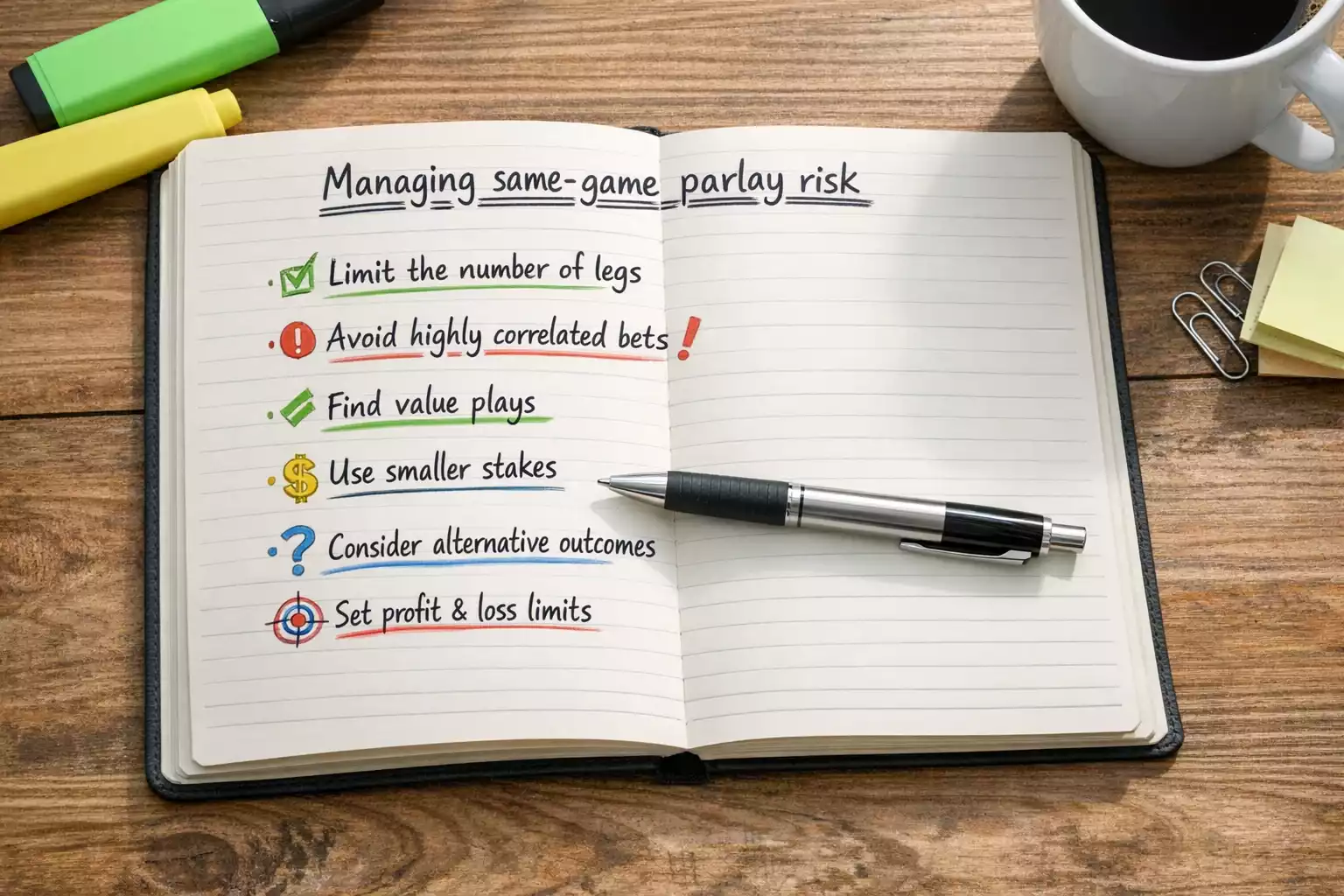
Keeping your leg count low is the single most important risk management principle for same-game parlays. Each leg you add multiplies your probability of losing even as it inflates the potential payout. The mathematics are unforgiving. A parlay with five independent 50 percent propositions has only a 3.125 percent chance of hitting. Add correlation adjustments, and your actual probability is even lower than the naive calculation suggests. Sticking to two or three carefully selected legs maximizes your chances of actually cashing tickets while still offering payouts meaningful enough to justify the exercise.
Partial SGP hedging offers a way to lock in profits or limit losses when early legs hit. If your three-leg SGP includes a first-quarter prop that cashes, you now hold what is effectively a two-leg parlay for the remainder of the game. Depending on live odds and your risk tolerance, you might bet against one of your remaining legs to guarantee profit regardless of outcome. This approach sacrifices maximum upside for reduced variance, a trade-off that makes sense when a significant win is already on the table and the remaining legs look less certain than when you originally placed the bet.
SGP insurance promotions from sportsbooks can shift the value equation when used strategically. These offers typically refund your stake as a free bet if exactly one leg loses. When a book is running this promotion, constructing parlays with one high-variance leg and two solid legs becomes mathematically attractive. If the risky leg misses but everything else hits, you get your stake back to try again. If everything hits, you cash a nice payout. The key is ensuring that the insurance offer genuinely improves your expected value rather than simply encouraging you to bet parlays you would not otherwise play.
Best Sportsbooks for NBA Same-Game Parlays
Comparing SGP features across sportsbooks reveals meaningful differences that affect your betting experience and potential returns. Some platforms offer more prop options per game, allowing for more creative and specific parlay construction. Others provide better correlation pricing on certain combinations, effectively offering higher payouts for the same underlying bet. The availability of alternate lines, where you can take a player over 22.5 points instead of the standard 24.5, varies significantly across books.
Boost opportunities appear regularly for SGPs at most major sportsbooks and can add genuine value when the enhanced odds overcome the book’s built-in margin. A 25 percent profit boost on a well-constructed parlay might push a marginally negative expected value bet into positive territory. However, boosts often come with restrictions on eligible props or maximum bet sizes that limit their utility. Read the fine print carefully and calculate whether the boost actually helps given your intended wager structure.
User experience considerations matter more for SGPs than for straight bets because the construction process requires comparing many options quickly. An intuitive interface that shows updated combined odds as you add legs saves time and reduces errors. The ability to save parlay templates for later modification helps when you want to make slight adjustments before game time. Mobile functionality is essential if you bet on the go. These seemingly minor features accumulate into significant quality-of-life differences when you are building multiple parlays per week.
Common SGP Mistakes
Adding too many legs is the most common SGP error because it feels intuitively wrong to leave money on the table. That six-leg parlay paying +1500 looks so much more exciting than the two-leg parlay paying +180. But excitement is not a betting strategy. Every additional leg reduces your win probability more than it increases your potential payout when correlation adjustments are properly accounted for. The math favors shorter parlays, and the math always wins over the long run.
Combining uncorrelated legs wastes the strategic advantage that SGPs offer. If your parlay includes selections that have no relationship to each other, you are paying a premium for the convenience of a single ticket rather than gaining any correlation-based edge. Worse, you might accidentally include negatively correlated legs that actively work against each other. Every leg in your SGP should connect to a coherent game narrative. If you cannot explain why two selections should hit together, they probably should not be combined.
Ignoring correlation penalties means accepting worse odds than the parlay deserves. Sportsbooks reduce payouts when outcomes are positively correlated, but the size of the reduction varies by book and by specific combination. Checking the same parlay structure across multiple platforms often reveals significant pricing differences. The book offering the best price has either made a correlation error in your favor or simply operates with lower margins on that particular market. Either way, betting where the odds are best over time compounds into substantial profit differences.
Chasing payouts over probability is the fundamental mistake that underlies most SGP losses. Constructing a parlay because the potential return looks impressive rather than because the combined probability is favorable is gambling for entertainment, not betting for profit. If you want to play long shots for fun, acknowledge that is what you are doing. If you want to make money, focus on expected value rather than maximum payout. The most profitable SGPs often have modest returns because they combine high-probability legs that are positively correlated. Unsexy, perhaps, but effective.
Constructing Your SGP Process
Building profitable same-game parlays requires a systematic approach that most bettors never develop. Start by analyzing the game independently of available betting markets. Form opinions about pace, scoring environment, and individual player opportunities based on matchup analysis and situational factors. Only after you have a clear game narrative should you examine the SGP options to see if the market offers value on your predictions.
Discipline means walking away from games where your analysis does not translate into attractive SGP opportunities. Not every game deserves a same-game parlay bet. Sometimes the sportsbook has priced your preferred combinations accurately, leaving no edge to exploit. Sometimes the available props do not align with your narrative in ways that create positive correlation. Forcing SGPs when the opportunity is not there guarantees long-term losses. Patience and selectivity outperform activity and volume.
Track your SGP results separately from your straight bets to understand whether this approach is actually profitable for you. The variance on parlays is higher than on individual wagers, so larger sample sizes are needed before conclusions become meaningful. If after several hundred parlays your results are significantly worse than your straight betting, the market might be efficiently pricing your combinations, or your correlation analysis might need refinement. Data-driven assessment prevents ego from overriding evidence.
Same-game parlays occupy a unique niche in sports betting where entertainment value and analytical opportunity coexist. Approach them as creative expressions of detailed game analysis rather than lottery tickets, and you might find they add both enjoyment and profit to your NBA betting portfolio. Approach them carelessly, and you will fund the sportsbook’s marketing budget one poorly constructed parlay at a time.
Recommend
Written by the editors at nbapropbets.com.
